Marvel Vs Capcom


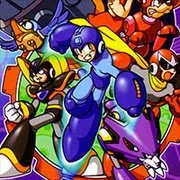
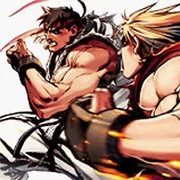
Marvel vs. Capcom: Clash of Super Heroes — Crossover Fighting Game Guide, Roster & Gameplay
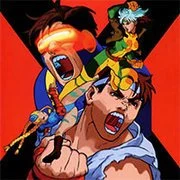
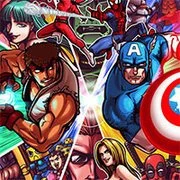
Marvel vs. Capcom: Clash of Super Heroes is a 1998 crossover fighting game that pits Marvel Comics icons against characters from Capcom’s deep video game catalog in fast, tag-team arcade battles. Players pick a team of two fighters and swap between them mid-match to chain combos, summon support characters, and unload screen-filling Hyper Combos.
Developed and published by Capcom, the game launched in Japanese arcades in February 1998 on the CP System II board, with a North American arcade release the following month. It is the third entry in the Marvel vs. Capcom series and a direct follow-up to Marvel Super Heroes vs. Street Fighter from 1997.
What Makes Clash of Super Heroes Different
Where the previous game stuck strictly to Street Fighter characters on the Capcom side, this one throws the doors wide open. Suddenly you’ve got Mega Man trading shots with Wolverine, Strider Hiryu clashing with Venom, and Morrigan from Darkstalkers stepping into the ring. That single change reshaped the whole identity of the series.
Two big mechanical shifts separate this entry from its predecessor. The old “Variable Assist” system — where you could call your partner in for a specific attack — is gone. In its place sits the Guest Character system, which randomly hands each player a Special Partner at the start of a match. You only get a few uses per round, so timing matters.
The headliner addition is the Variable Cross, sometimes called the Duo Team Attack. Trigger it and both your fighters appear on screen at once, hammering the opponent together for a short window. On top of that, the Hyper Combo Gauge becomes unlimited during a Variable Cross, letting you stack heavy-damage specials back-to-back. It’s chaotic — and that’s the appeal.
Tag-Team Combat Basics
Each match starts with a two-fighter team selection. You can tag your partner in whenever you want during a fight. The character resting offscreen slowly recovers health, which rewards smart rotation over just mashing with your favorite. Whoever empties the opponent’s life bar first wins. If the timer runs out, the team with more health left takes the round.
Game Modes
The Dreamcast port includes five modes: Arcade, Versus, Training, Survival, and Cross Fever. Arcade Mode sends you through a gauntlet of AI teams that ends with Onslaught — the same Marvel villain who anchored the publisher’s massive 1996 crossover storyline. Beating him triggers a unique cinematic ending for whichever character you used.
Versus Mode is your standard local two-player setup with adjustable handicaps and stage selection. Training Mode lets players grind out combos and tweak settings like AI difficulty and Hyper Combo bars. Survival pits you against wave after wave of enemies under a clock, with your health carrying between rounds — no resets, no mercy. Cross Fever pushes things further by letting four players join a two-on-two scrap at the same time.
The PlayStation version skipped Cross Fever and added Cross Over instead. It’s the only PlayStation mode that allows tag-team play, but with a twist: both players are forced to use identical teams. Pick Spider-Man while your friend picks Ryu, and the game auto-assigns the other character as each player’s secondary.
The Roster
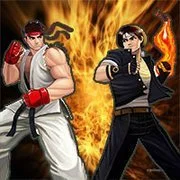
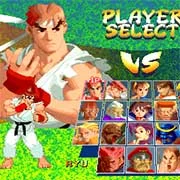
Fifteen regular fighters anchor the lineup, drawn from across Capcom’s franchises and Marvel’s hero catalog. The Marvel side includes Captain America, Gambit, Hulk, Spider-Man, Venom, War Machine, and Wolverine. From Capcom, you’ve got Captain Commando, Chun-Li, Jin Saotome, Mega Man, Morrigan Aensland, Ryu, Strider Hiryu, and Zangief.
Six secret fighters round things out, unlocked by entering codes on the character select screen. Most are palette swaps with reworked movesets — Shadow Lady is a modified Chun-Li, and there’s a tweaked version of Hulk pulled straight from Marvel Super Heroes. Roll, Mega Man’s sister, is the odd one out: she gets unique sprites but borrows most of her brother’s moves.
Special Partners
Beyond the main roster, the game features 22 Special Partner characters who can be summoned into battle for quick support strikes. Two of them are hidden. The Marvel partners include Colossus, Cyclops, and Jubilee. The Capcom side reaches deep into the publisher’s history — Arthur from Ghosts ‘n Goblins, Devilotte from Cyberbots: Full Metal Madness, the Unknown Soldier from Forgotten Worlds, Anita from Darkstalkers, Michelle Heart from Legendary Wings, Saki from Quiz Nanairo Dreams, and Ton Pooh from Strider. It’s a love letter to Capcom’s back catalog disguised as a fighting game.
Console Ports and Performance
Capcom brought the game home to Dreamcast on March 25, 1999 in Japan, October 7, 1999 in North America, and November 24, 1999 in Europe (where Virgin Interactive Entertainment handled the PAL release). That version is widely considered the cleanest translation of the arcade original, with the bonus four-player Cross Fever mode tacked on.
The PlayStation port had a harder time. Released on November 11, 1999 in Japan as Marvel vs. Capcom: Clash of Super Heroes EX Edition, then January 2000 in North America and Europe, it ran into the console’s RAM limits. Capcom stripped out tag-team play from most modes to preserve speed and visual fidelity. Animation frames were cut, especially from the larger character sprites. The trade-off worked — the game still ran fast — but reviewers consistently pointed back to the Dreamcast as the version to own.
Reception
The arcade original was a commercial hit. It landed as the second most successful arcade game in Japan for March 1998, and roughly 3,000 cabinets sold in the United States — enough to outperform Street Fighter III and briefly make it Capcom’s top-earning US arcade release of that period.
The Dreamcast port pulled strong reviews. Game Informer praised its animation and lightning pace. GameSpot’s Jeff Gerstmann called it everything you’d want from a flashy, over-the-top fighter. GameRevolution was the holdout, knocking the port for not adding much beyond the arcade experience. Famitsu gave it 33 out of 40.
The PlayStation version drew more mixed reactions. Gerstmann’s main complaint was the loss of tag-team battles, which he felt hollowed out the experience even when the individual moves stayed intact. IGN’s Douglass C. Perry called it average — solid gameplay and replay value, weaker soundtrack and roster variety. GamePro respected Capcom’s decision to cut features rather than ship a sluggish port, but still pointed players toward the Dreamcast.
Re-Releases and Legacy
The game has had a long second life. In 2012, it appeared in HD as part of the Marvel vs. Capcom Origins compilation for PlayStation 3 and Xbox 360, bundled with Marvel Super Heroes and adding online multiplayer, challenges, and replay saving. That collection was pulled from digital stores in December 2014 when Capcom’s Marvel licensing expired.
Arcade1Up released a home cabinet version in June 2020 that also included Marvel Super Heroes vs. Street Fighter, X-Men vs. Street Fighter, and Marvel Super Heroes in War of the Gems. The most recent return came in September 2024, when Capcom included Clash of Super Heroes in the Marvel vs. Capcom Fighting Collection: Arcade Classics for Nintendo Switch, PlayStation 4, and Windows. Toy Biz even produced a line of two-pack action figures during the original run, pairing Marvel and Capcom characters like Captain America with Morrigan and Spider-Man with Strider Hiryu.
A direct sequel, Marvel vs. Capcom 2: New Age of Heroes, arrived in 2000.
Game Controls
- Joystick / D-Pad — Movement, jumping, crouching
- Light Punch — Quick punch attack
- Medium Punch — Stronger punch attack
- Heavy Punch — Heaviest punch attack
- Light Kick — Quick kick attack
- Medium Kick — Stronger kick attack
- Heavy Kick — Heaviest kick attack
- Two Punch Buttons — Tag in partner
- Two Kick Buttons — Call Special Partner
- Special Motion + Two Attack Buttons — Variable Cross / Hyper Combo
Characters
Playable Characters


Assist-only Characters


As always, remember to have fun!