X-Men vs. Street Fighter










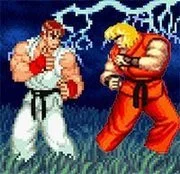
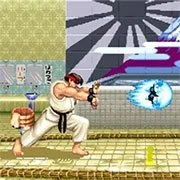




X-Men vs. Street Fighter – Classic Capcom Crossover Fighting Game
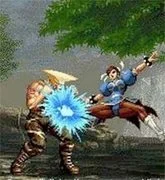
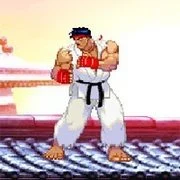
X-Men vs. Street Fighter is a 2D crossover fighting game developed and published by Capcom, pitting Marvel’s mutant heroes against the world warriors of the Street Fighter series. Released in arcades in September 1996, it became the first official entry in the Marvel vs. Capcom series and helped define tag-team fighting for a generation.
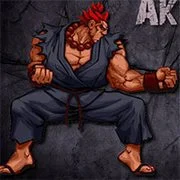
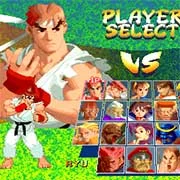
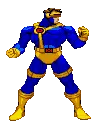
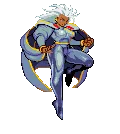
The game pulls characters from two giants of 90s pop culture and throws them into one ring. Wolverine, Cyclops, Storm, and Magneto stand shoulder to shoulder with Ryu, Chun-Li, M. Bison, and Akuma. Seventeen fighters in total, each built for over-the-top combat that leans hard into chaos.
Tag-Team Combat That Changed Fighting Games
Players pick two characters at the start of every match. Each fighter gets their own health bar, and you can swap between them whenever you want during a round. The off-screen partner slowly regains health while resting—a small mechanic with huge strategic weight. If one fighter falls, the second jumps in automatically. The match ends when both members of a team are knocked out.
Matches run as a single round rather than the typical best-of-three. That decision keeps fights fast and brutal. Run out of time, and whichever team has more combined health takes the win.
Hyper Combos and Aerial Mayhem
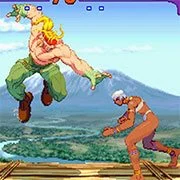
The combat borrows heavily from Capcom’s earlier Marvel titles, X-Men: Children of the Atom and Marvel Super Heroes. Super Jumps let fighters leap impossibly high. Aerial Raves chain combos in midair. The Hyper Combo Gauge fills as you land and absorb hits—spend it on screen-filling supers, dual-character Variable Combinations, or Variable Counters that turn a block into an immediate tag-in attack.
Capcom dialed everything up to keep the Street Fighter cast competitive with mutants who can fly, teleport, and throw lightning. Ryu’s Hadouken? Now it covers the entire screen. Akuma returns as a hidden character, just like his cameo in Children of the Atom.
Visuals Pulled Straight From the 90s
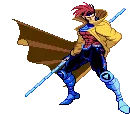
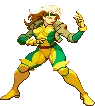
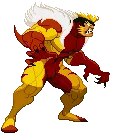
The X-Men sprites came directly from Children of the Atom, with Rogue, Gambit, and Sabretooth getting fresh designs since they hadn’t appeared in a Capcom fighter before. Every character is modeled after the 1990s X-Men animated series—same voice actors and all. Street Fighter sprites are recycled from Street Fighter Alpha 2. The result is a roster that looks ripped from Saturday morning cartoons, which is exactly the appeal.
Game Modes
Arcade Mode pits players against AI-controlled teams before a final showdown with Apocalypse, the iconic X-Men villain serving as the boss. Versus Mode handles local two-player battles. The PlayStation version adds Training Mode for drilling combos against passive opponents, plus Survival Mode for fighting endless waves.
Ports and Platform Differences
The Sega Saturn port arrived in Japan on November 27, 1997. It was the first game to use the Saturn’s 4 MB RAM cartridge, bundled with the disc, and the result was an almost arcade-perfect conversion. Critics loved it. The Saturn version never got an official North American release—Sega wouldn’t manufacture the 4 MB cart stateside, and U.S. retailers were already dumping Saturn inventory.
The PlayStation version, released in Japan on February 26, 1998 as X-Men vs. Street Fighter: EX Edition, had a rougher time. Memory limits forced Capcom to strip out animation frames and—most painfully—remove tag-team combat entirely. The second character only appears during specific moves like Variable Combinations. Matches got bumped to best-of-three rounds. A workaround code allowed pseudo-tag-team play, but only if each player used the opponent’s starting character as their partner. The Hyper Combo Gauge also fills twice as fast on PlayStation, making big supers more frequent.
Reception
The arcade original was a slow burn in North America before catching fire. In Japan, it topped Game Machine’s chart for October 1996. The Saturn port earned glowing reviews—GamePro handed out perfect scores in sound, control, and fun factor. Game Informer called it one of the best arcade conversions ever made.
The PlayStation version landed at 64% on GameRankings. Reviewers piled on the missing tag-team feature and constant slowdown. GameSpot’s Jeff Gerstmann argued Capcom shouldn’t have shipped it at all. IGN and Game Informer were kinder, calling it a decent fighter on its own terms—just nowhere near the Saturn version.
Legacy
Marvel Super Heroes vs. Street Fighter followed in 1997, swapping out most of the X-Men for other Marvel heroes like Spider-Man and Captain America. It introduced the “assist” mechanic that became a staple of the franchise. The original X-Men vs. Street Fighter was later included in Arcade1Up cabinets announced in June 2020, and resurfaced again in the Marvel vs. Capcom Fighting Collection: Arcade Classics for Nintendo Switch, PlayStation 4, and Windows in 2024.
Game Controls
- Directional buttons – Movement, jumping, crouching, blocking
- Three punch buttons – Light, medium, heavy punch attacks
- Three kick buttons – Light, medium, heavy kick attacks
- Tag button – Switch between your two selected fighters
- Special move inputs – Directional motions combined with attack buttons
- Hyper Combo – Specific directional input plus two attack buttons
Characters
X-Men
|
Street Fighter
|
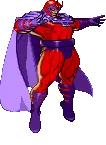


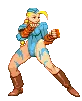

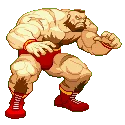
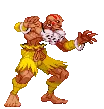
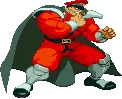
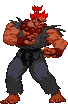
Boss character
| Sprite | Character | Summary |
|---|---|---|
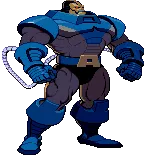 |
Apocalypse | Apocalypse is the final boss of the game, and thus lacks a tag partner. After defeating him, the character that defeated Apocalypse is forced to fight his or her teammate. Once the CPU-controlled teammate is defeated, the game will show the player-controlled character’s ending. |
As always, remember to have fun!